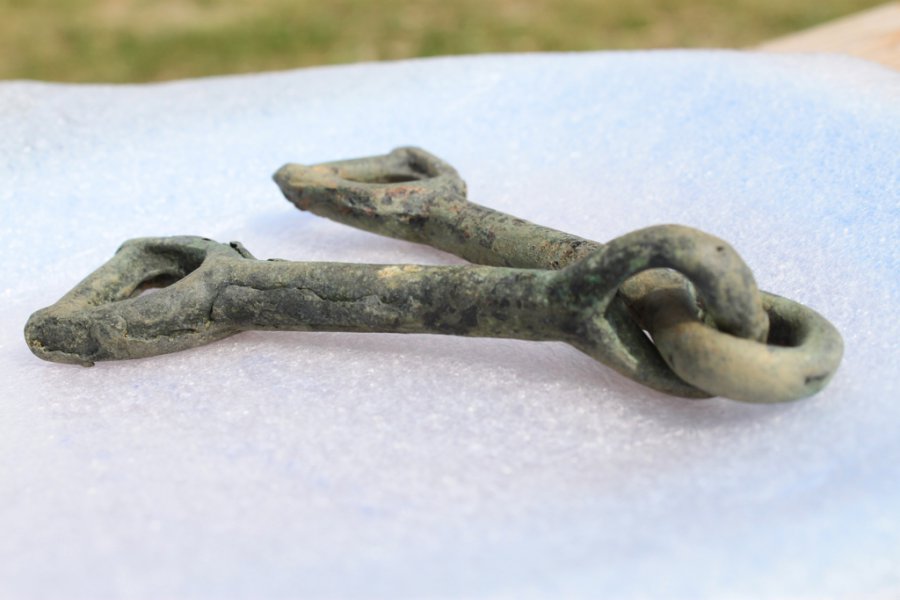
 Archeological excavations along the construction of Kyzyl-Kuragino railway, acting under the grant of Russian Geographical Society are going strong. Every week brings new finds. Scientists found a cast bronze bit, consisting of two parts - a part of horse harness. This find helped the archeologists to determine that the kurgan dates to Scythian era - 9th-6th centuries before our era. The scientists believe that the bit was made specially for the burial. Archeological excavations along the construction of Kyzyl-Kuragino railway, acting under the grant of Russian Geographical Society are going strong. Every week brings new finds. Scientists found a cast bronze bit, consisting of two parts - a part of horse harness. This find helped the archeologists to determine that the kurgan dates to Scythian era - 9th-6th centuries before our era. The scientists believe that the bit was made specially for the burial.
Archeologist Yuri Teterin discovered several artifacts also dating to Early Scythian period - 6th - 5th centuries before our era.
Among the finds were a bone pendant in the form of a moose hoof that served as decoration of clothing. The pendant was crafted in a special way: its surface was covered with ornamentation suggestive of the animal's hair.
The ancient nomads used sheep ankle bones (astragalus) found in the kurgan for the game of "bones", which is widespread among all South Siberian cultures. It is well known that the astragalus of ungulates has such a shape that if it falls on a horizontal surface it will stabilize in one of four possible positions - this quality makes it possible to use the bones for a game similar to dice.
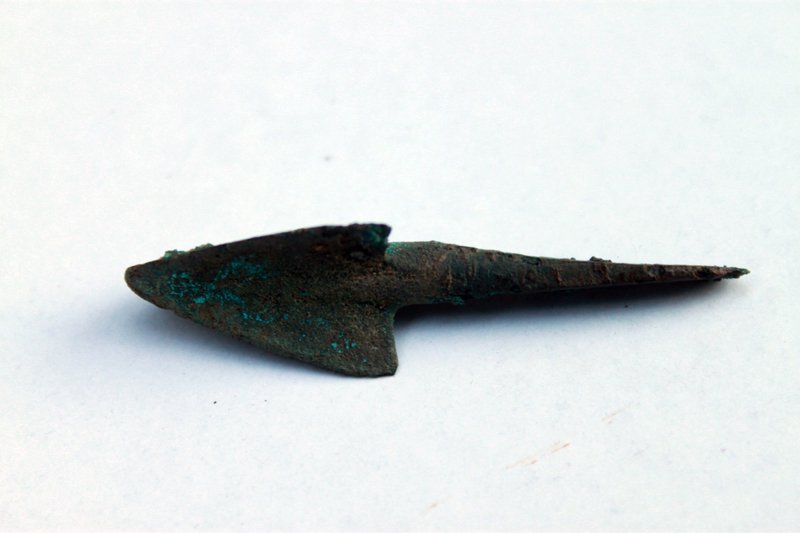
The archeologist also found a small bronze three-wing arrowhead and a turquoise plaque to be sewn onto headdresses and articles of clothing as a decoration.
 Objects dating to much earlier cultures were found too - artifacts from the Lower Paleolithic, or Middle Pleistocene in geochronological scale. Objects dating to much earlier cultures were found too - artifacts from the Lower Paleolithic, or Middle Pleistocene in geochronological scale.
The scientists found several universal tools - so-called "chopper", a pick-like tool, and a massive scraper used for cleaning skins. All these tools were used by Homo erectus approximately 200-250 thousand years ago, when the Earth was populated by wooly mammoths, giant rhinoceroses and other ancient species of animals. In the words of Novosibirsk archeologists, objects like that were typical for that period.
As the Russian Geographic Society web site notes, according to archeological report of Institute of history of material culture (IIMT), settlements appeared here 10600 years ago - already in the Holocene. However, in the words of members of the expedition, new finds point to the fact that first settlements appeared here significantly earlier.
|


 Society