Speakers of thousands of the world's languages are now abandoning their ancestral tongues at an unprecedented rate. What is lost when a language dies? And what are the implications?
"Languages are the repository of thousands of years of a people's science and art - from observations of ecological patterns to creation myths," says Swarthmore College linguist K. David Harrison, who spoke this weekend at the American Association for the Advancement of Science's annual meeting held this month in San Francisco.
 "The disappearance of a language is not only a loss for the community of speakers itself, but for our common human knowledge of mathematics, biology, geography, philosophy, agriculture, and linguistics." "The disappearance of a language is not only a loss for the community of speakers itself, but for our common human knowledge of mathematics, biology, geography, philosophy, agriculture, and linguistics."
In "When Languages Die: The Extinction of the World's Languages and the Erosion of Human Knowledge" (Oxford University Press 2007), Harrison argues that complex systems of knowledge are embedded in indigenous languages. He also examines why people stop using them and urges that they be documented before they are gone.
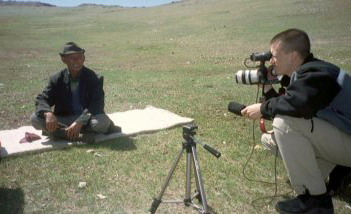
In his book, Harrison examines the human knowledge that is slowly being lost as the languages that express it - in Siberia, North America, the Himalayas and elsewhere - fade from sight. He uses anecdotes and portraits of some of these languages' last remaining speakers to demonstrate that this knowledge not only represents the cultural heritage found in oral histories and poetry, but useful knowledge about plants, animals, the seasons, and other aspects of the natural world.
Harrison is a specialist in Tuvan and other Siberian languages and has conducted field research on endangered languages of South Siberia and Western Mongolia since 1996. During field expeditions, he lives and travels with nomadic people, accompanying them on their seasonal migrations as they herd camels, horses, yaks, and sheep. He has also worked with one of the last speakers of the Karaj language in Lithuania and documented language and ethnography in Eastern India and the Philippine highland rice terraces.
|


 Culture